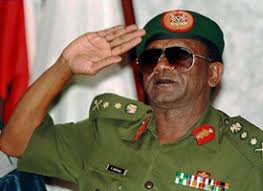
General Sani Abacha, born on September 20, 1943, was Nigeria’s
military head of state from November 17, 1993 to June 8, 1998 when he
died suddenly. It is exactly 18 years since he died, but how much of his
history do you still remember?
1. A Kanuri originally from Borno State, General Sani Abacha was born and brought up in Kano state, which he made his home.
2.
He married a Shuwa Arab, Maryam, also from Borno state, in 1965 and
they had six boys and three girls. The first child, Ibrahim, died in a
plane crash in 1996.
3. The last of their children was
born in Aso Rock in 1994 when Abacha was 50 and his wife 47. The boy was
named Mustapha, supposedly after Abacha’s chief security officer, Hamza
al Mustapha.
4. Abacha was the first and only military head of state who never skipped a rank to become a full-star general.
5.
Abacha announced the coup that brought an end to the government of
President Shehu Shagari on December 31, 1983, and brought Major-Gen.
Muhammadu Buhari to power.
6. After Buhari was overthrown
in a palace on August 27, 1985, it was Abacha that announced the chief
of army staff, Major-Gen. Ibrahim Babangida, as the new military
president and commander-in-chief of the armed forces in an evening
broadcast (the coup speech was read by Brigadier Joshua Nimyel
Dogonyaro).
7. On appointment as chief of army staff in
1985, he caused a stir when he said the issue of “second in command” to
Babangida had not been resolved, even though Commodore Ebitu Ukiwe, as
chief of general staff, was understood to be holding the position. It
was later resolved in favour of Ukiwe.
8. Abacha was
commissioned 2nd lieutenant in 1963 after he had attended the Mons
Defence Officers Cadet Training College in Aldershot, England.
9.
He was believed to have participated fully in the July 1966
countercoup, which led to the death of the head of state, Major-Gen.
Johnson Aguiyi-Ironsi, and subsequently resulted in the civil war.
10.
Officially, he did not overthrow the interim national government in
1993. The head of government, Chief Ernest Shonekan, resigned and
Abacha, being the secretary of defence and the most senior member of
government, took over. Unofficially, it was a bloodless coup.
11.
He was known as a man of “few words and deadly actions” and he
demonstrated this as head of state with one of the most brutal regimes
Nigeria has ever had. There was massive crackdown on the media, civil
rights groups and pro-democracy campaigns.
12. Two of the
most important recommendations of the 1995 constitutional conference he
set up are: 13% derivation for oil-producing areas and six
geo-political zones.
13. He never held a non-military
appointment in his career until he became minister of defence in 1990
(later re-designated secretary of defence in 1993). He was a Lt. Gen
then.
14. His supporters describe him as a good economic
manager and that he stabilised exchange rate at N22/$1 but the
unofficial rate was N80/$1. This created colossal rent-seeking, with
many “chosen” associates buying at the official rate and reselling at
four times the rate in the black market.
15. It was under
Abacha that Nigeria became a perpetual importer of petroleum products,
as all the refineries packed up. However, 17 years after his death,
Nigeria is still heavily dependent on fuel imports.
16.
An unforgettable phenomenon under Abacha was the importation of “foul
fuel” which had an offensive odour and damaged car engines.
17. He was instrumental to the restoration of peace and democracy in Sierra Leone and Liberia after years of civil wars.
18.
He increased fuel price just once in his four-and-a-half years in
office and set up the Petroleum (Special) Trust Fund, which was widely
acknowledged to have performed well in infrastructural development and
intervention programmes in education, health and water.
19.
His wife set up what is now known as the National Hospital, Abuja. It
was originally named National Hospital for Women and Children before it
was upgraded into what is intended to be Nigeria’s no. 1 public
hospital.
20. His death is shrouded in mystery: the most
popular version is that he died in the midst of Indian prostitutes flown
in from Dubai but the official version is that he died of heart attack.
A more likely story is that he was “eliminated” to end the political
crisis in Nigeria.
Compiled by Nashir Yakiuba


